




This article was reviewed and approved by certified nutritionist Samantha Lerviken on February 8, 2024.
Sometimes it feels like no matter what we do, the scale just won’t budge. We eat well, exercise regularly, and stay away from treats, but the number on the scale remains stubbornly the same. But did you know that our physical health is about so much more than just the number of pounds we weigh?
The human body is incredibly complex and consists of various substances, all of which have different densities. So when you feel slimmer but your weight is still the same as before, you may have gained muscle mass and lost fat.
What is an InBody test?
Since a standard scale doesn’t account for the difference in weight between fat and muscle, an InBody can be a useful tool for better understanding your body. Measuring your body composition with an InBody gives both you and your coach, nutritionist, or personal trainer a deeper understanding of your body, its needs, and your progress.
InBody an advanced scale that, instead of just measuring your weight, analyzes your body composition—including fat, muscle, and water. It does this by sending small electrical impulses through your body. Since fat, muscle, and water have different electrical properties, InBody can distinguish between them and calculate how much of each is present in your body.
How does an InBody work?
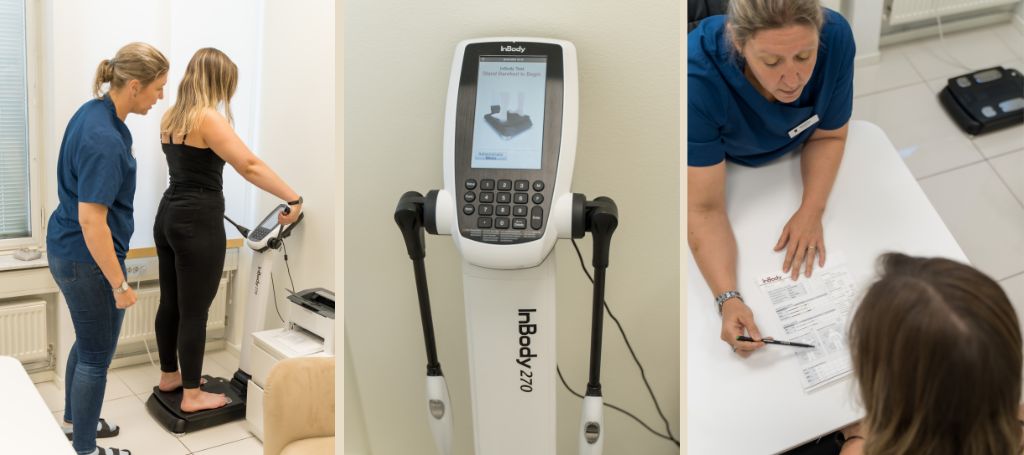
The measurement is taken by standing barefoot on a scale and holding two handles, allowing small electrical impulses to pass through your body. The resistance encountered by the signals is recorded, providing an estimate of the proportions of fat, muscle, and water in your body.
The electrical impulses are very weak, so you won’t feel them during the measurement, but you should still avoid taking an InBody if you have a pacemaker or are pregnant, just to be on the safe side.
InBody can provide you with insights into:
- How much muscle mass you have on your body: we usually have more muscle mass than we think, and this component accounts for most of the weight.
- How your muscles are distributed throughout your body: perhaps you use one side of your body more than the other, or maybe you’re particularly strong in your arms. InBody can detect this.
- How much body fat you have: having too high or too low a body fat percentage isn't good, and the scale can give you an idea of where you stand
- The type of fat your body is made up of: visceral fat—the fat found between your organs—can be dangerous, but your body needs subcutaneous fat to stay healthy. InBody can measure your percentage of visceral fat and give you an estimate of how much you need to lose.
- How your muscle mass and body fat compare to the average for a large group of people your age: it can be interesting to see how your body stacks up against others—maybe you’re in better (or worse) shape than you think?
- How much water your body contains: if you’ve been drinking a lot or eating foods high in salt—which causes your body to retain fluid—you may weigh more without actually having more body fat. A bathroom scale doesn’t provide this insight.
As you can see, an InBody provides a wealth of information that you simply can’t get from a bathroom scale and a tape measure alone. This also means you can compare your body more accurately before and after a workout program to see exactly how much your body improved as a result of your efforts.
Whether your goal is to lose weight, build muscle, or improve your overall health, InBody can be a tool to help you gain the insights you need to see that you’re heading in the right direction.

Things to keep in mind before an InBody
During the measurement itself, stand barefoot on InBody and hold the handles with your arms outstretched, one in each hand.
You don’t need to do anything during the measurement itself. Just stand relaxed with your feet on the marked spots on the scale. The measurement usually takes 2–3 minutes, and you won’t feel the faint electrical signals being sent through your body.
We usually recommend that you avoid eating or drinking right before the measurement, as food and drink in your stomach can affect the results and be interpreted by the scale as body fat. It’s also best to avoid exercising right before the measurement, as physical activity can affect your body’s water balance and thus the results of the measurement.
What do the results of an InBody mean?
After the measurement, you will receive a printout with all the results. If you have InBody done at Estetikcentrum always Estetikcentrum a consultation with our trained nutritionist, who can explain what the results mean and where you specifically need to make improvements. Without this insight, it can be difficult to understand what the numbers mean or to take action based on the results.
If you have a specific goal or are following a training program, we recommend that you get an InBody regularly so you can track your progress along the way. A gap of about 2–4 weeks is usually sufficient to see a difference.
InBody provides a good starting point for setting goals and working toward a healthier body composition. It can be used by anyone who exercises, whether you’re planning to undergo abdominoplasty with or without liposuction, or if you’re participating in our Allurion or Saxess programs.
Would you like to book an InBody at Estetikcentrum Malmö? You can do so by clicking here.


